
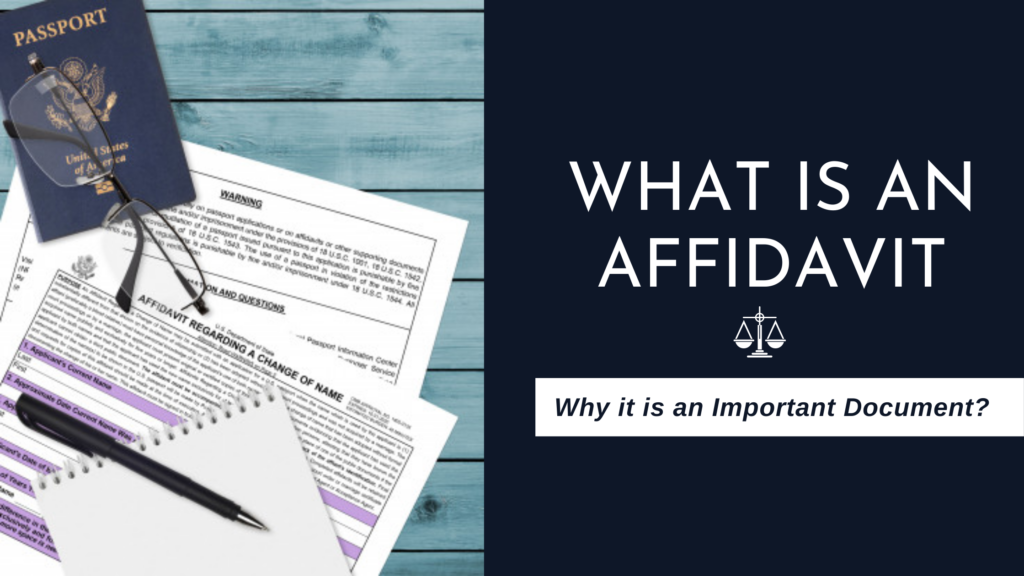
An Affidavit is a verified statement of true facts in writing, sworn-in especially under oath or, as an affirmation before an authorized officer or magistrate.. An Affidavit is considered as a relevant evidence under Section 3 of Indian Evidence Act, 1872. Therefore, submitting a false affidavit before the court is a punishable offence.
Affidavit is required in some situations which are mentioned hereunder focusing upon its relevance:
1. An affidavit may support an entry into any form of contract or an agreement.
2. An affidavit has to be filed while instituting a case in the court of law.
3. An affidavit is also required while applying for any government jobs.
4. An Affidavit is also considered when one has to state truth on oath.
5. An affidavit is attached for mobile phone or sim lost.
6. An affidavit is also given for anti-ragging declaration to be submitted to a University.
7. An affidavit is required at the time of change of name.
8. An affidavit is also required for issuing birth certificate or death certificate etc.
9. An affidavit is also required for any Mobile SIM lost or identity cards loss for re-issuing the same by statutory bodies.
10. When a director is appointed to a company then he requires to give an affidavit accordingly.
Therefore, an Affidavit has broader significance and relevance in so many ways even outside the court of law.
However, there are certain stages of cases in which you may have to draft an affidavit, such are:
1. To state receiving of legal documents.
2. To notify a creditor or other party of someone’s death.
3. To make claim on any assets or property.
4. To verify one’s residency.
5. To verify a change in your name.
Credibility & Relevance of an affidavit can be clearly understood as it is an admissible evidence in a court of law. False facts on oath are strictly punishable as these are considered to be contempt of court.
Thus, this document is signed by the person(s) making statement called an affidavit and also by a person who is legally authorized to administer an oath such as an ‘Oath Commissioner’ or a ‘Notary public’ as the case may be. Thus, an Affidavit should be always treated as a serious document.